Better Business Bureau
A Boy and His DogThe Better Business Bureau is the principal civic institution encountered by Vic after his descent into the Topeka Downunder. It presents itself as an ordinary office of respectable local administration, but its function in the narrative is more coercive than bureaucratic: the institution receives Vic as a captured outsider, removes his weapons, and serves as the headquarters from which the Downunder’s elders explain their need for men and attempt to control his future. Its bland public identity therefore becomes an emblem of a society whose polished order rests on surveillance, confinement, and the regulation of reproduction.
Headquarters of the Downunder’s Order
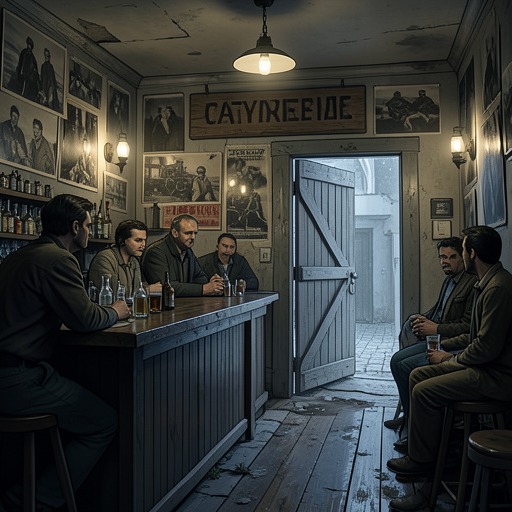
The Better Business Bureau occupies a shopfront in Topeka’s business section. After a green tracked box carries Vic through the town, it turns through the open door beneath the words BETTER BUSINESS BUREAU displayed on the window. The choice of location makes the office look like part of the town’s familiar civic landscape, alongside its shops, gas station, newspaper corner, and other carefully maintained features. Yet the apparent normality is immediately disrupted by the scene inside: half a dozen men, including very old men, and two women are waiting for him.
The office is organized around age, procedure, and controlled access. One man takes the metal plate that enabled Vic’s passage through the access dropshaft and hands it to Lew, the oldest of the elders. Lew places it in the top-left drawer of a rolltop desk, turning a device connected with movement and escape into an item held by the institution. At Lew’s command, Aaron removes Vic’s guns and searches him. The green box releases Vic only after his arms have been held numb by its cable-mounted mittens, and the office thus completes the capture begun in the street: technology restrains him, while the Bureau’s personnel inventory and disarm him.
Civic Respectability and Coercion
The Better Business Bureau’s name is an ironic administrative mask. Lew describes the Downunder as quiet, orderly, prosperous, and governed by respect for elders, with no crime and a generally pleasant way of life. The office embodies that self-image through its elderly authority figures, its desk and drawers, and the calm sequence of commands by which Vic is processed. Even Mez’s hostility is contained by Lew, who tells her to leave Vic alone while he tries to speak sense. The institution’s civility is therefore not mere background decoration; it is the language through which authority claims legitimacy.
Vic experiences that civility as another form of pressure. The residents’ porch rocking, lawn raking, organized recreation, communal swimming, shopkeeping, and ceremonious greetings produce a society that appears peaceful but feels to him like a sealed container. He sees the Downunder as a metal tube with a town built inside it, a place lacking weather, wilderness, animals running wild, and freedom. The Bureau belongs to this same contradiction. It is a recognizable civic office in a world that imitates the surface, yet its respectable procedures conceal the fact that Vic has no meaningful choice about remaining there.
The Reproductive Program
Lew uses the Better Business Bureau as the setting for the Downunder’s central explanation of Vic’s capture. He tells Vic that the community has lived beneath Topeka for close to thirty years and has grown and prospered, but its reproductive system is failing: some inhabitants can no longer have children, and the women who do give birth have mostly girls. The community therefore needs men of a particular kind. Vic is explicitly told that he is an experiment for them, making the Bureau the institutional point at which a person becomes a proposed solution to a demographic problem.
This language transforms reproduction into public administration. Vic is not welcomed as an individual or treated as a guest whose wishes matter; he is assessed according to his usefulness to the population. The Bureau’s orderly setting sharpens the violence of that reduction. Nothing about the office’s name, furniture, or civic routine announces a breeding program, yet the institution’s authority is directed toward securing precisely that biological resource. The Downunder’s social stability depends on converting intimacy and sexual capacity into matters of collective policy.
Vic’s Return to the Bureau
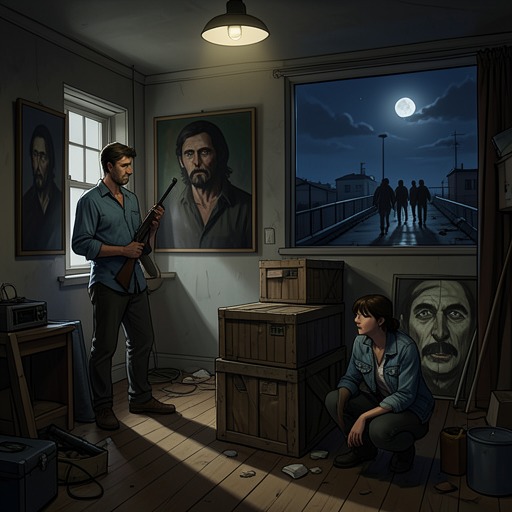
Vic eventually escapes from the Holmes household with Quilla June Holmes, but the Better Business Bureau remains the place where his confiscated equipment is stored. The locked case there contains his .30-06 rifle, .45 pistol, ammunition, spike, knife, and kit. To reclaim these objects, Vic returns to the office carrying a crowbar taken from the gas station. A clerk tries to stop him, and Vic strikes the clerk with the crowbar before prying open the cabinet in Lew’s office and loading himself with his weapons and supplies.
The reversal is significant. During his first visit, the Bureau’s machinery and officials act upon Vic: the green box carries him in, Aaron searches him, and Lew takes possession of the access plate. During the second, Vic forces entry and turns the institution’s carefully secured storage against it. The office that had made him defenseless becomes the site where he reconstitutes himself as an armed fugitive. Its authority is not peacefully negotiated away; it is breached through the same direct violence that the Downunder’s civic order claims to have eliminated.
Narrative Significance
The Better Business Bureau concentrates the Downunder’s defining paradoxes. The settlement reproduces the visual grammar of a surface town—business district, houses, lawns, civic offices, and polite social rituals—while existing inside a gigantic sealed metal cylinder. The Bureau intensifies that imitation by borrowing the name of a familiar public institution and placing it at the center of a system that imprisons outsiders and manages reproduction. Its ordinary label cannot contain the extraordinary coercion performed under it.
The institution also links the story’s major conflicts: the opposition between freedom and enclosure, between individual desire and collective survival, and between genuine attachment and socially engineered usefulness. Vic’s capture there follows his discovery that the Downunder is “canned,” while his later return follows his decision to flee with Quilla June Holmes and recover Blood’s place in his life. In that movement, the Bureau becomes more than a location. It is the bureaucratic face of a closed society, and its destruction as a secure holding place marks Vic’s refusal to let the Downunder define him as property, specimen, or reproductive instrument.